 Gary Claven
Why the Old Way Is Dying — and the New Way Isn’t Optional
If you’re a business owner, a media buyer, or an agency still clinging to the idea that Google Ads is just about keywords and intent — this is your wake-up call. Not because change is coming. But because it’s already here. And it’s eating your lunch.
What’s Actually Happening?
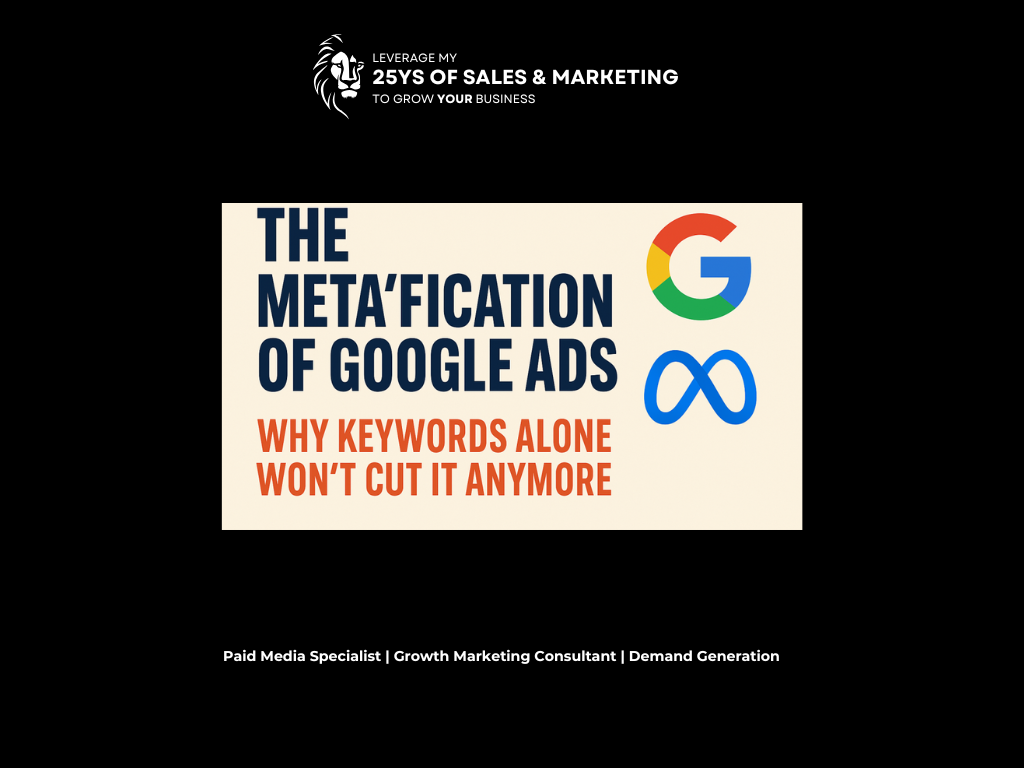
Google Ads is no longer just a search platform. It’s becoming a behavioural ad engine — one that mirrors Facebook, Instagram, and TikTok more than it does the Google Ads of 2015.
This isn’t a rebrand. It’s a transformation.
Let me make it plain:
- Keywords still matter. But they’re no longer king.
- Creative matters more. Because attention is the new currency.
- Data is the new targeting. Because Google wants to know who buys — not who clicks.
- AI is running the show. And most of you are giving it the keys without checking who’s driving.
Because what used to be a serious, bottom-of-funnel, direct-intent channel…
Is now being rewired to behave like a content and entertainment platform.
And if you want to win in this new era? You’re going to have to build like it.
Part 1: How Google Ads is Changing (and Why You Can’t Ignore It)
1. From Search to Feed
Let’s start here:
When most people think of Google Ads, they think of the search box. Someone types a keyword. You bid on it. You get the click. Simple, right?
Not anymore.
Google has introduced Demand Gen campaigns. These don’t even touch the search network. They run on YouTube, Gmail, and the Discovery feed — surfaces where people scroll, swipe, and consume content.
If this sounds like Facebook… it’s because it is.
Except now, it’s being supercharged with Google’s data and AI.
Your best customers might never type a keyword again. But they’ll still be reachable — in feeds, in video suggestions, and in inbox tabs.
So here’s the first truth you have to face:
If your ad strategy only exists in search, you’re playing in the smallest sandbox.
2. Keywords Aren’t Dead — But They’re Not the Whole Game
For years, media buyers lived and died by keyword match types, search term reports, and negative keyword sculpting.
That’s still part of the toolbox. But it’s not enough.
Google now wants you to build campaigns around audience signals — the people behind the search, not just the words.
Why? Because they’re following Meta’s lead.
They know the buyer journey is non-linear. That users search, watch, read, scroll, and compare across multiple platforms. That intent isn’t just about what someone types — it’s about what they consume.
Performance Max campaigns operate on this logic. You give Google:
- A product feed
- A few audience signals
- Some creative assets
- Your conversion data
And it builds a campaign across YouTube, Display, Gmail, Search, and Shopping — all in one.
If that makes you nervous, good. It should.
Because the control you used to have? It’s gone. And if you don’t know how to speak Google’s new language, you won’t be heard.
3. Creative Is the New CRO
This is the most under-discussed truth in paid media right now:
Your creative is your targeting.
In a world where platforms are auto-optimising placements, bids, and delivery — the only thing you have full control over is what you say and how you show up.
Video. Image. Hook. Headline. CTA.
These aren’t fluff anymore. They’re the whole game.
And in Demand Gen or Performance Max campaigns, the creative is the strategy.
If your ads can’t stop the scroll, they can’t drive the click. If they don’t create desire, they can’t convert. If they don’t teach, show, prove, or entertain — they don’t work.
Want an edge? Build creative like a performance asset. Test angles. Rotate formats. Speak to specific buying objections.
Think UGC, not studio shoots. Think 5-second hook, not 2-minute brand piece. Think “This ad makes me stop” — not “This ad looks pretty.”
4. AI Isn’t a Tool Anymore — It’s the Platform
Google isn’t just using AI.
Google is AI now.
It’s running your bids. Your placements. Your ad rotation. Your creative suggestions. Your search queries.
And very soon — it’ll be answering your customers’ questions for them, before they even see your site.
Gemini 2.0 is Google’s move toward conversational AI — where your ad might show up as a sentence, not a search result.
That means:
- Fewer ad placements
- More automated delivery
- Higher competition
And unless you’re training the algorithm with great data — conversion values, offline uploads, CRM signals — you’re feeding it junk.
You don’t win this game by fighting the AI. You win by partnering with it — giving it the inputs only a human strategist can:
Real buyer psychology. Real customer data. Real business logic.
Part 2: Why This Is Happening (And Why It’s Not Going Back)
1. User Behaviour Is Evolving
Let me ask you something:
When was the last time you typed a 4-word keyword into Google?
Better yet — when was the last time you asked ChatGPT, instead?
If you’re anything like millions of others, that habit is already changing. You want answers, not options. Conversations, not lists.
Google knows this.
Which is why it’s moving away from blue links and toward AI Overviews, Gemini answers, and feed-based experiences.
And when search becomes dialogue, not query — ad placements shrink.
That’s why:
Fewer ads will be shown. To more users. With higher costs.
And if you’re not running top-of-funnel campaigns to educate your audience before they ever search… you’ll be invisible.
2. The Platforms Are Collapsing
Here’s what I mean:
- TikTok has a search engine now
- Google is behaving like Meta
- Meta is becoming more like YouTube
Everything is overlapping.
The old idea of “Google is for intent, Facebook is for attention” is dead.
You need to treat Google like a full-funnel platform — because it is.
Feed. Video. Search. Shopping. Display. Gmail.
It’s all one ecosystem now. And your campaigns need to follow the user — not the channel.
Part 3: What To Do About It (The Playbook)
This is the part most people skip. They give you the headlines and hope you figure it out.
Let me make it actionable.
Step 1: Shift to Full-Funnel Thinking
Most advertisers start at the bottom:
- Keywords
- Product feed
- Shopping ads
That’s great — if people are already searching for you.
But what about the 95% who aren’t?
Build your funnel top-down:
- Top of Funnel: Demand Gen, YouTube, Display. Use visuals, hooks, and storytelling.
- Middle of Funnel: Retarget with Performance Max, Gmail, Discovery.
- Bottom of Funnel: Nail your branded search and shopping.
Pro Tip: If you’re only running one campaign type, you’re not running a funnel. You’re just fishing with one line.
Step 2: Build or Buy Better Creatives
Creative isn’t an afterthought anymore — it’s the driver.
Here’s how to level up:
- Batch shoot UGC content monthly (you can do this with a phone)
- Use testimonials as video ads
- Create 15-30 second explainers with text overlays
- Test 3 hooks per ad (first 5 seconds = everything)
Don’t know where to start? Ask your customers:
“What made you hesitate before buying from us?”
Then build a creative that answers it.
Step 3: Fix Your Data Flow
If Google can’t tell who’s a good lead or customer — you lose.
For ecom: Make sure your pixel fires correctly, your purchase values are accurate, and you’re passing back product-level data.
For lead gen: Upload offline conversions. Integrate your CRM. Use enhanced conversions.
Pro Tip: Set up value-based bidding, even for leads. Assign values to leads based on real close rates.
Step 4: Let the AI Learn — Don’t Fight It
You can’t outsmart the algo. But you can train it faster.
Feed it great:
- Audience signals
- Conversion data
- Ad creative
Then let it run. Stop tinkering every 24 hours. Stop restarting learning. Let performance stabilise.
Google is building the roads. Your job is to drive the best car.
Final Thoughts: This Is The Fork In The Road
You have two options:
Option 1: Keep running the same search campaigns you did in 2019, and complain that your CPCs are going up and your leads are drying out.
Option 2: Adapt. Learn. Build like it’s Meta. Test like it’s TikTok. Track like it’s Salesforce. And partner with the AI that’s now steering the future of search.
You don’t have to love the changes. But if you want to win — you do have to evolve.
Remember:
Keywords used to be king. Now, attention is queen. And the kingdom belongs to those who master both.
Let’s build.

 Gary Claven