Case Study / Google Ads Rebuild
The fix wasn't a bigger budget. It was a three-campaign structure, each doing one job.
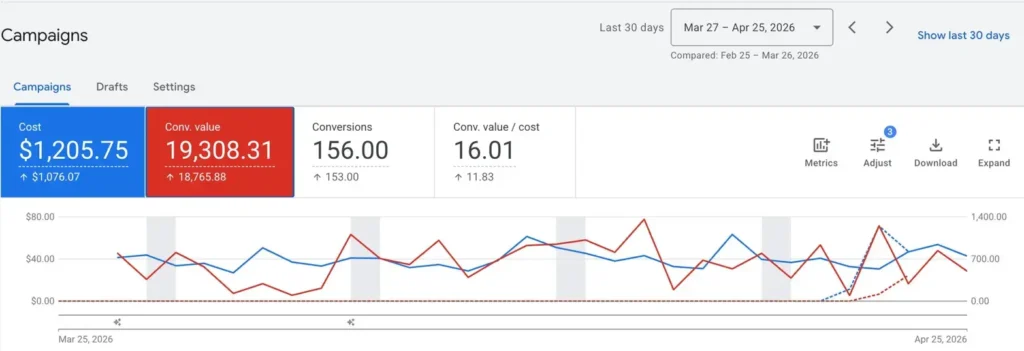
A direct-to-consumer Jeep accessories brand inherited an underperforming Google Ads account: minimal spend, three conversions a month, no clear structure. Thirty days after a full rebuild, the same account returned 16x on ad spend across 156 conversions, on a budget under £1,300.
|
Spend
$1,205
+830%
|
Revenue
$19,308
+3,460%
|
Conversions
156
+5,100%
|
ROAS
16.01x
+283%
|
01 / The Brief
An ecom account running cold, with no clear job for any campaign.
The brand sells niche Jeep accessories direct to consumer. Strong product, strong margin, loyal community on the organic side. The Google Ads account did not reflect any of that.
When the account came across, it had been sitting in a holding pattern for months: roughly $130 a month in spend, three conversions to show for it, and a structure that made it almost impossible to read what was actually happening.
Brand search, generic prospecting, and Performance Max were all running through a single tangled structure with overlapping keywords, shared budgets, and no clear separation of intent. Brand traffic was being attributed to PMax. PMax was eating cheap branded clicks and reporting them as prospecting wins. Generic search was getting throttled because there was no dedicated budget protecting it.
The first job was diagnostic, not creative. Before touching a single ad, the priority was working out what each campaign was supposed to do, and rebuilding the account so the answer to that question was unambiguous.
What the audit surfaced
- Brand cannibalisation. PMax was bidding on branded queries and claiming the conversions, masking the true cost of prospecting.
- No budget separation. One shared daily budget meant the cheapest clicks (brand) absorbed spend before generic or PMax got a fair shot.
- Conversion tracking gaps. Purchase events were firing but value was not being passed back consistently, so ROAS in the platform was unreliable.
- Asset starvation in PMax. Three images, two headlines, one video. No audience signals. The algorithm had nothing to work with.
02 / The Reset
30 days before, and 30 days after.
Same account. Same products. Same audience. The only thing that changed was structure, tracking, and how budget was allocated against intent.
|
|
||||||||||||||||||||
03 / The Rebuild
Three campaigns. Three jobs. No overlap.
The principle was simple: every campaign should have one job, one budget, and one way of being judged. If a campaign could not answer the question "what are you here to do," it did not belong in the account.
|
Campaign 01
Brand SearchDefend branded queries. Capture intent already in the funnel. Stop PMax from claiming credit for traffic it did not earn. Job: Protect existing demand. |
Campaign 02
Generic SearchTightly themed ad groups around high-intent product categories. Branded terms excluded as negatives. Manual CPC to start, tCPA once the conversion data was clean. Job: Win new buyers actively searching. |
Campaign 03
Performance MaxBrand terms excluded at the account level. Audience signals fed in. Asset group rebuilt with full creative library, lifestyle imagery, and video. Budget capped to prevent it eating the account. Job: Scale incremental, non-brand demand. |
Tracking was rebuilt at the same time. Purchase value passed back cleanly, brand and non-brand reporting separated, and a simple weekly review cadence put in place so optimisation decisions were based on the right denominator, not the platform's default view.
04 / What Moved the Needle
Structure first. Creative second. Budget last.
|
01
|
Separating brand from non-brand alone exposed where the real waste was. Roughly 40% of pre-rebuild conversions were branded clicks being claimed by PMax. |
|
02
|
Asset density in PMax moved the algorithm from guessing to learning. More headlines, more lifestyle imagery, audience signals, and a proper product feed gave the system enough surface area to optimise against. |
|
03
|
Negative keyword discipline in generic search cut off the wasted clicks that had been masking what the account could actually do. Search term reviews twice a week for the first 14 days. |
|
04
|
Budget was the last lever pulled, not the first. Spend went up because the structure could finally absorb it profitably. If the rebuild had not come first, more budget would have meant more waste at scale. |
05 / The Takeaway
Most underperforming Google Ads accounts do not need more budget. They need a structure that tells you what is actually working.
A 16x return on a $1,200 budget is not a creative win or a bidding hack. It is what happens when each campaign has one clear job, brand and non-brand are reported separately, and the account is structured so the data you are reading is the data you can actually trust.

 Gary Claven